
One of the questions I get most often, especially as the Crimson Alliance Universe continues to expand, is:
“Why do you write such different story lengths?”
Some books are full-length ensemble novels (400+ pages).
Some are mid-sized interludes (around 250 pages).
Some are shorter adventure Tales (10 chapters plus an epilogue).
And others are micro-stories designed as short, powerful snapshots (5 chapters plus an epilogue).
The answer is simple, but it’s also the foundation of everything I’m building:
Not every story needs the same amount of space. Different story lengths allow me to explore adventure, world-building, and character development in the way each moment deserves.
The CAU was never designed as a linear series. It’s a galaxy of cultures, histories, conflicts, and deeply personal journeys. To honor that, I need the freedom to let each story take the shape that serves it best.
Here’s how each story format contributes to the larger tapestry of the Crimson Alliance Universe.
1. Full-Length Ensemble Novels: The Cinematic Adventures
When readers open A Demon’s Rebellion or future mainline novels, they’re stepping into the largest and most cinematic arcs of the CAU.
These novels are where:
-
Multiple character threads intersect
-
Major battles reshape planets—or an entire galaxy
-
Political, cultural, and spiritual themes unfold
-
The Crimson Alliance moves forward together
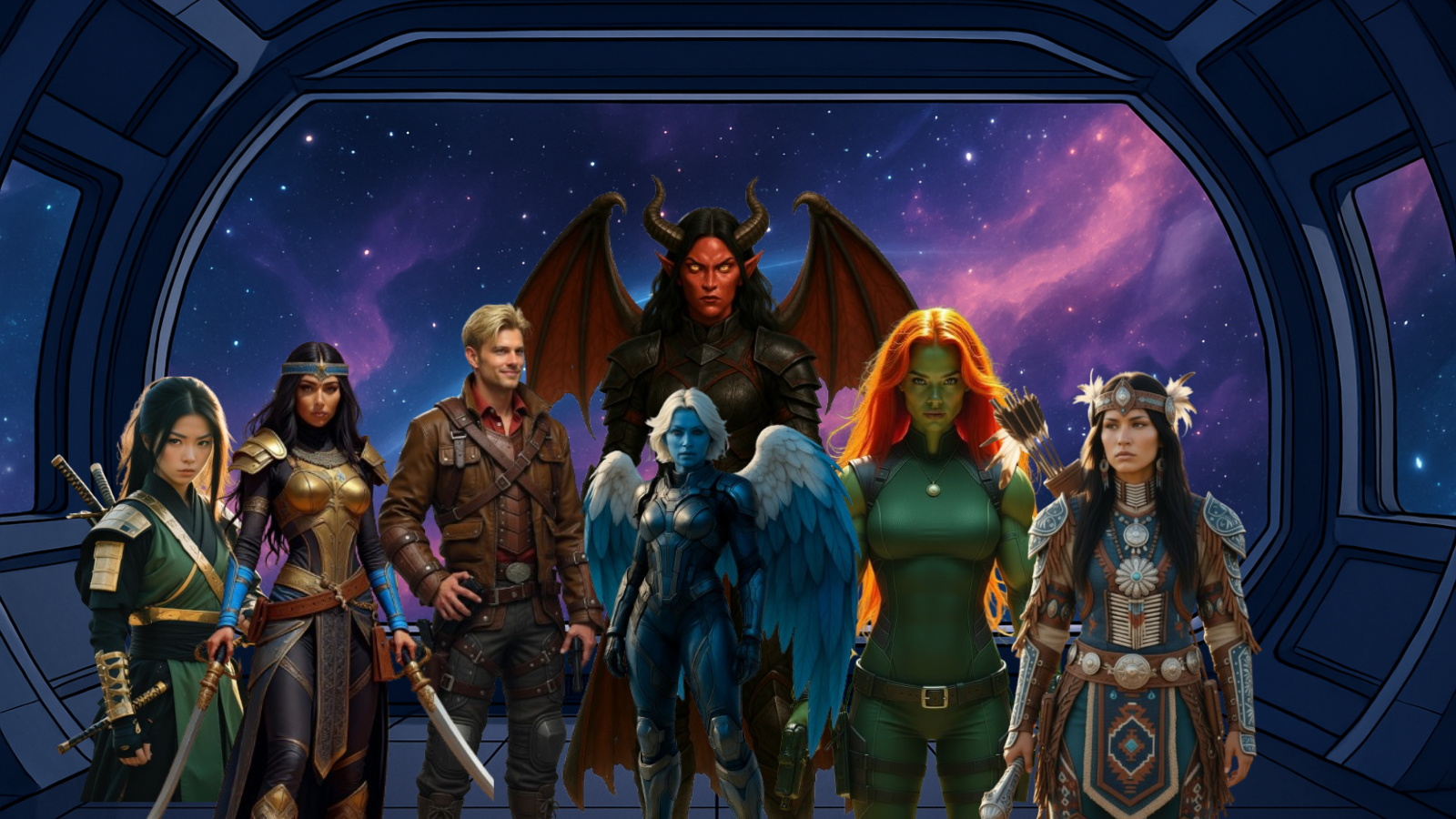
A Demon’s Rebellion needed its scope because it was the team’s first major test as a unified force. The story had to introduce and build foundations for Lilith, Rainstorm, Adrian, Grilka, Freija, Kimiko, and Nefertari – seven wildly different beings – and show how a collection of strangers becomes a family. That kind of emotional and narrative weight cannot fit in a short story or an interlude.
Full-length novels are the pillars of the CAU.
They are the moments when the galaxy truly changes.
But not every story is galaxy-changing—and that’s where shorter formats shine.
2. Interludes: Character Journeys Too Personal for a Full Cast
An interlude (also called an interquel) is a shorter novel featuring one or two characters who step away from the ensemble to have an adventure of their own. Think of them as the CAU’s equivalent of an Iron Man movie versus an Avengers movie.
Some of the most meaningful moments in a character’s life don’t happen during massive battles or multi-system missions. They happen:
-
In quiet corners of the galaxy
-
During unexpected detours
-
In moments no one else witnesses
That’s why I created (after having my first 90 minute conversation with AI in March 2025) the Interludes – stories designed for intimacy and focus.
Sunlight & Shoreline is the perfect example. Adrian and Grilka don’t need a galaxy-wide conflict for their story to matter. Their undercover mission on Ona is humorous, tense, personal, and rooted deeply in identity. It explores trust, deception, vulnerability, and how two very different people learn to rely on each other when everyone around them might be a clone.
The story would have been overshadowed if it had to share space with Lilith’s fire, Rainstorm’s spirituality, Freija’s flight, or Nefertari’s royal presence. It had to be smaller, quieter, and more focused.
Cold Front is technically a full novel, but the reasoning is the same: Icelandia’s politics, rituals, spiritual heritage, and the fierce bond between Freija and Frigid required a spotlight all their own. That kind of world-building simply cannot be compressed.
Interludes serve a crucial purpose: They let characters evolve when the galaxy isn’t exploding.
3. Tales (10-Chapter Stories): Focused Adventures That Expand the Galaxy
The CAU is enormous – culturally, politically, spiritually.
But not every captivating corner of the universe needs 300 pages.
That’s why I created the CAU Tales: ten-chapter, fast-paced adventures built around a single idea, location, or mission.
Tales are perfect for:
-
Side adventures
-
Cultural deep dives
-
World-building expansions
-
Standalone conflicts
-
Character-focused moments
-
History, folklore, and myth explorations
This is exactly why Smuggler’s Gambit exists. Adrian’s past… with Rafe Juno, with Kevan Drailis, with the shadows of old smuggling routes – needed room to breathe, but not the scale of a mainline novel. A Tale was the perfect size.
The Tournament of Snowfall was created for a similar reason. Frigid deserved her own spotlight – her pride, her skill, her rivalry, her heritage, and her growth. She didn’t need a giant war. She needed a stage.
Tales can also explore:
-
Rainstorm’s Navajo-inspired spirituality
-
Nefertari’s Chantress lineage
-
Grilka’s Valkorrian traditions
-
Freija’s adaptation to Earth
-
Icelandian myths and legends
They let readers experience the CAU in small, powerful bursts.
I also plan to bundle around seven Tales into a single anthology so readers can either enjoy the full collection or collect each Tale individually with its own unique cover.
4. Micro-Tales: Moments That Matter
Finally, there are the micro-tales. Short, condensed stories used as lead magnets or subscriber bonuses.
These include:
-
5 chapters plus an epilogue (epilogues are part of the CAU’s DNA)
-
Emotional snapshots
-
Character introspections
-
Quiet or intense moments that don’t fit anywhere else
For new readers, micro-tales act as a welcome mat to the CAU – quick glimpses into tone, character, humor, or heart.
For long-time fans, they’re treasures: the missing scenes, the private reflections, the personal growth moments tucked between the big adventures.
Thousand Lanterns is a perfect example. It doesn’t need a sprawling narrative… it needs atmosphere. A mysterious mountain shrine, flickering lantern light, ancient spirits, and a threat best solved by intuition rather than warfare. It’s a small but emotionally rich slice of the CAU.
5. Why All These Lengths Matter (The Real Reason)
The Crimson Alliance Universe is built on three pillars:
Adventure
Some stories need to be enormous. Some need to be intimate.
Scale is a tool—not a rule.
World-Building
Different lengths allow me to explore entire planets or single rituals, depending on what the story requires.
Character Development
The heart of the CAU is always the characters, and their biggest growth moments don’t all happen on battlefields or starships.
If I forced every idea into a full-length novel, I’d dilute the emotional impact.
If I limited myself to shorter works, the galaxy would feel too small.
By using different story lengths, I get to respect each story, honor each character, and build a universe that feels genuinely alive—not because every book is massive, but because every story is the right size for the moment it’s telling.
Closing Thought
The CAU is not a straight line.
It’s a constellation.
Each story – long or short – is a star.
Together, they form something brighter, richer, and more meaningful.
Different story lengths let me build a galaxy one experience at a time, and I hope readers enjoy exploring every corner of it as much as I enjoy writing it.
To get updated information in the CAU, join our mailing list.